














Summary
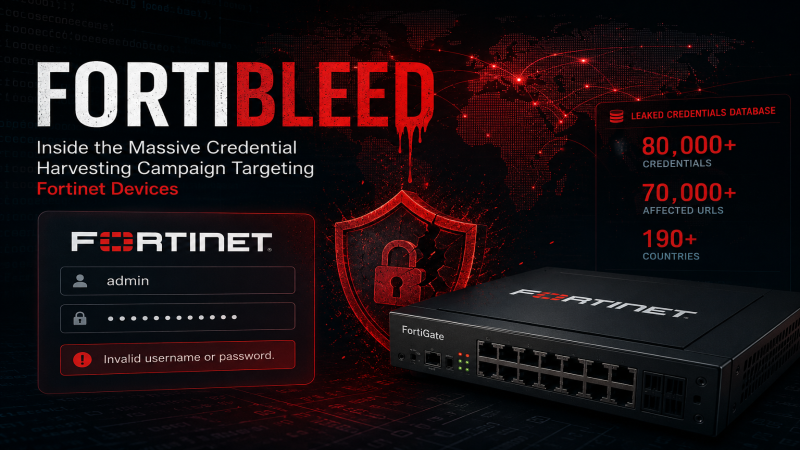
A sweeping credential harvesting campaign, tracked under the name “FortiBleed,” has been disclosed, compromising valid login credentials for tens of thousands of internet facing Fortinet firewalls and SSL VPN portals worldwide. The exposed accounts span enterprises, financial institutions, and government bodies across 190+ countries. Because these are working credentials to perimeter security appliances, the exposure provides attackers with a direct, authenticated path into corporate networks that bypasses many traditional defenses. This briefing explains how the credentials were likely obtained, why firewall and VPN credential leaks are uniquely dangerous, how threat actors operationalize them, and the concrete steps organizations should take now.
What Is FortiBleed?
FortiBleed is the name assigned to a body of exposed credential data tied specifically to Fortinet perimeter devices, primarily FortiGate firewalls and their associated SSL VPN web portals. The dataset is reported to contain more than 70,000 distinct firewall login URLs, with affected hosts identified across 190+ countries.
It is important to frame this accurately. FortiBleed is not, at its core, a single zero-day exploit firing across the internet. It is a credential-exposure event: a large collection of valid usernames and passwords mapped to the management and VPN login pages of Fortinet appliances. The danger lies not in a novel vulnerability but in the fact that the keys to the perimeter are already in circulation. For a defender, that distinction matters, because patching alone does not close an exposure built on legitimate credentials.
The affected hosts share a recognizable fingerprint: bare IP addresses or hostnames serving a login page over HTTPS, frequently on non-standard management ports. These are exactly the externally reachable interfaces that organizations expose to enable remote administration and remote-access VPN, and exactly the interfaces an attacker most wants to reach.
Scope and Impact of the Exposure
The breadth of the exposure is what elevates FortiBleed from a routine credential leak to a systemic concern. Several characteristics stand out:
• Scale: Tens of thousands of unique firewall login endpoints are represented, indicating the harvesting was broad and opportunistic rather than narrowly targeted.
• Global distribution: Affected devices appear across nearly every region, including high-value organizations in finance, energy, telecommunications, and government services.
• Sector sensitivity: Many of the impacted entities operate critical infrastructure or hold regulated data, raising the stakes of any successful intrusion well beyond a single compromised host.
• Persistent exposure: A significant proportion of affected devices remained internet-accessible after the credentials were harvested, meaning the window for abuse stayed open long after the initial compromise.
In practical terms, every entry in a dataset like this represents a potential pre-authentication foothold. An attacker does not need to develop an exploit or evade a vulnerability scanner; they need only to log in. That economy of effort is precisely what makes valid-account exposure so attractive to intrusion operators and initial access brokers alike.
How Attackers Likely Harvested the Credentials
No single mechanism explains an exposure of this size. Based on the patterns that have been described and on well-established tradecraft, the credentials were almost certainly aggregated from several overlapping sources:
Information-stealer malware
The dominant source of large modern credential datasets is infostealer malware. When a stealer infects an employee, contractor, or administrator workstation, it harvests credentials saved in browsers, VPN clients, and password stores. Critically, it also records the URL each credential was saved against. When an administrator has saved a FortiGate login in their browser, the resulting stealer log contains the firewall’s address, the username, and the password as a neatly packaged triple. Aggregated across many infections, these logs produce exactly the kind of URL-to-credential mapping observed in FortiBleed.
Historical vulnerability exploitation
Fortinet appliances have been the subject of multiple high-impact vulnerabilities over the past several years, including flaws that allowed credential or configuration disclosure. Credentials extracted during earlier exploitation waves can persist in attacker hands for years, especially where passwords were never rotated after patching. Some entries in a dataset of this kind may trace back to those earlier campaigns.
Configuration and secret exposure
Leaked or misconfigured device backups, exposed configuration files, and reused administrative passwords all contribute to the pool. Once a configuration file leaks, it can reveal not only credentials but also network topology, VPN settings, and trust relationships that make subsequent abuse far easier.
The common thread is that none of these vectors requires breaching the firewall at the moment of attack. The credential was captured elsewhere, often on an endpoint the security team never associated with the perimeter device, and then resold, traded, or published on underground sources.
The group’s tradecraft reportedly extends beyond harvesting and reuse. Hudson Rock and independent reviewers assess that the operators intercept SSL-VPN authentication, crack captured hashes on a 45-GPU cluster managed through Hashtopolis, and pivot into internal Active Directory environments for follow-on exploitation and persistence.
How the Loop Sustains Itself, and What Fortinet Says
Compromised devices are then repurposed as listening posts that capture additional credentials passing through them, producing a continuous loop of unauthorized access. Notably, password complexity offers little protection in this model, because many recovered credentials are obtained in plaintext and replayed directly against the perimeter.
Researcher Kevin Beaumont, who independently reviewed the dataset, states the credentials are legitimate and that the exposed FortiGate management interface is reachable from the internet in most affected cases, with the data appearing to originate from exports of device configuration.
Fortinet characterizes the collection as a resharing of credentials from previous incidents combined with brute-force attempts, rather than the result of a new vulnerability or breach. A Fortinet spokesperson stated the company is aware of the reported third-party credential-harvesting campaign targeting its firewalls and VPN gateways, that it continuously monitors threat actor activity, and that organizations following routine best practices, including regular credential rotation and multi-factor authentication, face minimal risk from the credential exposure described in the reporting.
Why Compromised Firewall Credentials Are Critical
Firewalls and VPN concentrators occupy a uniquely sensitive position. They sit at the network boundary, they are deliberately exposed to the internet, and they are trusted to enforce the very controls that separate “outside” from “inside.” A valid credential to one of these devices undermines that trust at its foundation.
• They bypass perimeter defenses by design. An authenticated VPN login is expected, legitimate traffic. It does not trip intrusion-detection signatures the way an exploit would, and it often originates from infrastructure designed to look ordinary.
• They grant network-level access. Unlike a single compromised SaaS account, a firewall or VPN login frequently places the attacker directly onto the internal network, behind the perimeter, with routable access to internal systems.
• They enable persistence. Administrative access to the appliance itself lets an attacker create rogue accounts, alter firewall rules, disable logging, or establish covert tunnels that survive password resets elsewhere.
• They are hard to detect. Because the activity is authenticated and the device is trusted, abuse can blend into normal administrative and remote-work patterns for extended periods.
This is why initial access brokers prize perimeter-device credentials so highly. A working firewall login is among the most direct routes to a full enterprise compromise, and it commands a premium on underground markets precisely because of how much downstream access it unlocks.
How Threat Actors Weaponize Exposed Credentials
Exposed perimeter credentials rarely sit idle. They feed a well-defined operational workflow that intrusion operators repeat across victims:
1. Validation. Operators test harvested credentials at scale to confirm which logins still work, discarding stale entries and prioritizing live access.
2. Initial access. Using a valid VPN or firewall login, the attacker authenticates directly into the environment, with no exploit, no malware delivery, and no phishing required at this stage.
3. Reconnaissance and privilege escalation. Once inside, the attacker maps internal systems, identifies domain controllers and high-value hosts, and seeks paths to elevate privileges, often abusing additional weak or reused credentials discovered internally.
4. Lateral movement. Leveraging native tools and stolen credentials, the attacker moves between hosts, expanding control while minimizing the use of obvious malware.
5. Objective execution. The endgame varies: data theft and extortion, deployment of ransomware across the estate, or quiet long-term espionage. In ransomware cases, perimeter access dramatically shortens the time from intrusion to encryption.
Frequently, the operator who harvests or buys the credential is not the one who executes the final objective. Initial access brokers specialize in obtaining and validating footholds, then selling them to ransomware affiliates or other actors. This division of labor means a single exposed firewall credential can change hands several times, each transaction increasing the likelihood that it is eventually used against the organization.
Indicators Organizations Should Monitor
Detecting abuse of exposed perimeter credentials requires looking at the right signals. Security teams should watch for:
• VPN or firewall administrative logins from unfamiliar geolocations, hosting providers, or anonymizing infrastructure.
• Successful authentications to perimeter devices outside of normal administrative hours or from accounts that rarely log in remotely.
• Creation of new local accounts, unexpected changes to firewall rules, or modifications to logging and VPN configuration on perimeter appliances.
• Impossible-travel patterns or concurrent sessions for the same VPN account from disparate locations.
• Appearances of corporate domains, device hostnames, or administrator usernames in infostealer logs and underground credential dumps.
The last point is decisive. By the time anomalous logins appear in firewall telemetry, the attacker may already be inside. Identifying the exposed credential before it was used, while it is still circulating in a stealer log or on an underground forum, is the difference between prevention and incident response.
Recommended Mitigations
Closing a credential-based exposure requires more than patching. The following actions, prioritized for impact, address both the immediate risk and the conditions that allowed it:
• Rotate all perimeter credentials now. Treat every administrative and VPN account on internet-facing Fortinet devices as potentially exposed. Reset passwords and invalidate active sessions, including service and break-glass accounts.
• Enforce multi-factor authentication everywhere. MFA on VPN and administrative access is the single most effective control against valid-account abuse. A harvested password is far less useful when a second factor stands between it and access.
• Restrict management exposure. Administrative interfaces should not be reachable from the open internet. Limit access to trusted source addresses, place management behind a bastion or out-of-band network, and disable unused remote-access features.
• Patch and verify firmware. Apply current Fortinet firmware and confirm that historical vulnerabilities are fully remediated. This means not merely patched, but followed by credential rotation, since patching does not expel an attacker who already holds valid logins.
• Audit device configuration. Review firewall rules, local accounts, administrative profiles, and VPN settings for unauthorized changes. Look specifically for rogue accounts and altered logging.
• Harden the endpoint estate. Because infostealers are a primary source of these credentials, strengthen endpoint protection, restrict credential storage in browsers for privileged users, and treat any stealer infection on an administrator’s machine as a potential perimeter compromise.
• Strengthen monitoring and logging. Ensure perimeter devices forward authentication and configuration-change logs to a monitored SIEM, and build detections for the indicators listed above.
• Establish continuous exposure monitoring. Proactively track whether corporate credentials, domains, and device identifiers surface in underground sources, so exposed logins can be rotated before they are weaponized.
Why Continuous Dark Web Monitoring Matters
FortiBleed underscores a shift in how enterprises are breached. The decisive event is increasingly not an exploit fired at the perimeter but a credential quietly harvested from an endpoint, then traded and resold across underground markets and credential-trading channels for weeks or months before it was used. Validated access to perimeter devices is routinely advertised and brokered in these venues, which is precisely why a credential can change hands several times before an intrusion begins. Defenses focused solely on the moment of attack miss this earlier, more actionable window.
Continuous monitoring of underground sources, stealer-log marketplaces, and credential trading channels gives security teams visibility into that window. When an organization learns that its firewall login appears in a fresh dataset, it can rotate the credential, force re-authentication, and harden the device before an attacker validates and uses it. This reframes exposure from an after-the-fact discovery into an early warning signal.
This is the role DarkEntry is built to fill. By tracking credential exposure and dark web activity tied to an organization’s domains, infrastructure, and people, DarkEntry helps security teams identify compromised perimeter and VPN credentials early, turning leaked data into a defensive advantage rather than the opening move of an intrusion.
Key Takeaways
• FortiBleed is a large-scale exposure of valid Fortinet firewall and SSL VPN credentials affecting tens of thousands of devices worldwide.
• The core risk is valid-account abuse: working credentials let attackers authenticate straight past perimeter defenses.
• Infostealer malware, historical vulnerability exploitation, and configuration leaks are the most likely sources of the exposed credentials.
• Perimeter-device credentials are sought after by initial access brokers because they unlock direct, network-level access and enable persistence.
• Patching alone is insufficient. Credentials must be rotated, MFA enforced, and management exposure reduced.
• Continuous dark web and credential-exposure monitoring provides the early warning needed to act before exposed logins are weaponized.
Regional Exposure: Affected Organizations Across the Arab World
While FortiBleed is global in reach, the exposure carries particular weight across the Arab region, where a concentrated set of high-value organizations appears in the dataset. DarkEntry has identified 115 affected domains spanning seven countries: the United Arab Emirates, Qatar, Egypt, Kuwait, Saudi Arabia, Oman, and Libya. The affected entities are not limited to a single industry. They include telecommunications carriers, banks and investment firms, government ministries, law enforcement bodies, healthcare providers, energy and construction companies, education institutions, and hospitality operators.
The concentration of government and critical-infrastructure domains in this regional subset is notable. A working credential to a perimeter device operated by a ministry, a police authority, or a national telecom carrier offers an attacker a direct foothold into networks that hold sensitive citizen data and underpin essential services. Each organization listed below should treat its Fortinet management and VPN credentials as exposed, rotate them immediately, and review perimeter devices for unauthorized access.
Affected Domains by Country
|
Country |
Affected Domains |
|
United Arab Emirates |
49 |
|
Qatar |
22 |
|
Egypt |
19 |
|
Kuwait |
14 |
|
Saudi Arabia |
6 |
|
Oman |
3 |
|
Libya |
2 |
|
Total |
115 |
Full List of Affected Organizations
|
Domain |
Country |
Sector |
|
aaadubai.com |
United Arab Emirates |
Automotive Services |
|
abcdubai.net |
United Arab Emirates |
Business Associations / Chambers of Commerce |
|
access-dubai.com |
United Arab Emirates |
Business Consulting & Corporate Services |
|
adek.gov.ae |
United Arab Emirates |
Government & Education |
|
agu.ac.ae |
United Arab Emirates |
Education & Academia |
|
appdubai.ae |
United Arab Emirates |
Information Technology |
|
awqaf.gov.ae |
United Arab Emirates |
Government & Religious Affairs |
|
citynetdubai.com |
United Arab Emirates |
Information Technology & Network Services |
|
cpecc.ae |
United Arab Emirates |
Energy & Engineering |
|
cqdubai.com |
United Arab Emirates |
Construction & Real Estate |
|
dhmun.shj.ae |
United Arab Emirates |
Government & Municipal Services |
|
dmt.gov.ae |
United Arab Emirates |
Government & Urban Planning |
|
dubaiplatform.com |
United Arab Emirates |
Media & Information Portals |
|
e3dubai.com |
United Arab Emirates |
Events & Marketing |
|
egov.fujairah.ae |
United Arab Emirates |
Government & Digital Services |
|
ehs.gov.ae |
United Arab Emirates |
Government & Healthcare |
|
eim.ae |
United Arab Emirates |
Automotive & Machinery |
|
emaar.ae |
United Arab Emirates |
Real Estate & Development |
|
emirates.net.ae |
United Arab Emirates |
Telecommunications & ISP |
|
etihadwe.ae |
United Arab Emirates |
Government & Utilities |
|
etisalat.ae |
United Arab Emirates |
Telecommunications |
|
fng.ae |
United Arab Emirates |
Conglomerate / Diversified |
|
hindutempledubai.com |
United Arab Emirates |
Religious Institution / Community |
|
infosalons.ae |
United Arab Emirates |
Events & Technology |
|
jmsdubai.com |
United Arab Emirates |
Trading & Commercial Services |
|
mbrsc.ae |
United Arab Emirates |
Aerospace & Technology |
|
mfldubai.com |
United Arab Emirates |
Manufacturing & Industrial |
|
mhsolutionsdubai.com |
United Arab Emirates |
Business Services & Consulting |
|
netwaydubai.com |
United Arab Emirates |
Information Technology & Telecommunications |
|
neweradubai.com |
United Arab Emirates |
Trading & Wholesale |
|
nicuae.ae |
United Arab Emirates |
Real Estate & Investment |
|
nihalhoteldubai.ae |
United Arab Emirates |
Hospitality & Tourism |
|
nnhs.ae |
United Arab Emirates |
Healthcare |
|
npcc.ae |
United Arab Emirates |
Energy, Oil & Gas Construction |
|
odeondubai.ae |
United Arab Emirates |
Food & Beverage / Restaurant |
|
onetouchdubai.com |
United Arab Emirates |
Information Technology |
|
oscdubai.com |
United Arab Emirates |
Industrial Manufacturing |
|
provis.ae |
United Arab Emirates |
Real Estate & Property Management |
|
psd.rak.ae |
United Arab Emirates |
Government & Public Works |
|
purplerockdubai.com |
United Arab Emirates |
Information Technology & Cyber Security |
|
ramadadowntowndubai.com |
United Arab Emirates |
Hospitality & Tourism |
|
romeodubai.com |
United Arab Emirates |
Interior Design & Contracting |
|
saintmarysdubai.org |
United Arab Emirates |
Education / Religious Institution |
|
savoydubai.ae |
United Arab Emirates |
Hospitality & Tourism |
|
shjpolice.gov.ae |
United Arab Emirates |
Government & Law Enforcement |
|
srta.gov.ae |
United Arab Emirates |
Government & Transportation |
|
uab.ae |
United Arab Emirates |
Banking & Finance |
|
verde-dubai.com |
United Arab Emirates |
Food & Beverage / Restaurant |
|
vudubai.com |
United Arab Emirates |
Entertainment & Lifestyle Portals |
|
aeb-qatar.com |
Qatar |
Architecture & Engineering |
|
alandalus.qa |
Qatar |
Education |
|
almeera.com.qa |
Qatar |
Retail & Consumer Goods |
|
arabiqatar.com |
Qatar |
Engineering & Trading |
|
atcom.com.qa |
Qatar |
Technology & Communications |
|
dchqatar.com |
Qatar |
Healthcare |
|
diss.com.qa |
Qatar |
Education & Safety Training |
|
ezdanholding.qa |
Qatar |
Real Estate & Investment Holding |
|
ezdanpalace.qa |
Qatar |
Hospitality & Tourism |
|
fsqatar.com |
Qatar |
Facility Management & Services |
|
mbkgroup.qa |
Qatar |
Conglomerate / Diversified |
|
msdf.gov.qa |
Qatar |
Government & Social Development |
|
oryx.edu.qa |
Qatar |
Education & Academia |
|
qatar.net.qa |
Qatar |
Telecommunications & ISP |
|
qcareqatar.qa |
Qatar |
Medical Equipment & Services |
|
qcbc.com.qa |
Qatar |
Healthcare & Biotechnology |
|
qimc.com.qa |
Qatar |
Manufacturing & Industrial Investment |
|
rmart.qa |
Qatar |
Retail & Supermarkets |
|
seamlessqatar.com |
Qatar |
Events & Technology |
|
technosoft.qa |
Qatar |
Information Technology |
|
tqamsa.com |
Qatar |
Professional Associations / Services |
|
vodafone.qa |
Qatar |
Telecommunications |
|
afaaqegypt.com |
Egypt |
Finance & Investment |
|
almansour.com.eg |
Egypt |
Automotive & Retail |
|
alqaed-eg.com |
Egypt |
Manufacturing & Trading |
|
breadfast.com |
Egypt |
E-commerce & Food Delivery |
|
egyptseaagency.com |
Egypt |
Shipping & Maritime |
|
egyscan.com |
Egypt |
Healthcare & Diagnostics |
|
mediterraneo-egypt.com |
Egypt |
Agriculture & Commodities |
|
myf-egypt.org |
Egypt |
Non-Profit & Healthcare |
|
nacegypt.com |
Egypt |
Education |
|
nfsa.gov.eg |
Egypt |
Government & Food Safety |
|
nppa.gov.eg |
Egypt |
Government & Energy |
|
premieregypt.com |
Egypt |
Financial Services |
|
ris-egy.com |
Egypt |
Education |
|
seegypt.com |
Egypt |
Tourism & Hospitality |
|
sodicclubs.com |
Egypt |
Sports & Real Estate Leisure |
|
tatariegypt.com |
Egypt |
Textiles & Manufacturing |
|
thg-egypt.com |
Egypt |
Healthcare & Pharmaceuticals |
|
vantageegypt.com |
Egypt |
Food & Beverage |
|
watanegypt.tv |
Egypt |
Media & Broadcasting |
|
alsafakw.org.kw |
Kuwait |
Non-Profit & Charity |
|
bestwesternkuwait.com |
Kuwait |
Hospitality & Tourism |
|
bicargo.com.kw |
Kuwait |
Shipping & Logistics |
|
cinnabonkuwait.com |
Kuwait |
Food & Beverage |
|
gpfkuwait.com |
Kuwait |
Finance & Investment |
|
kotc.com.kw |
Kuwait |
Shipping & Logistics |
|
kuwaitroute.com |
Kuwait |
Travel & Tourism |
|
rankkuwait.com |
Kuwait |
Marketing & Advertising |
|
regency.com.kw |
Kuwait |
Hospitality & Tourism |
|
sak.com.kw |
Kuwait |
Real Estate & Construction |
|
sultan.com.kw |
Kuwait |
Retail & Consumer Goods |
|
ufm.com.kw |
Kuwait |
Media & Broadcasting |
|
ulckuwait.com |
Kuwait |
Legal Services |
|
wecarekuwait.com |
Kuwait |
Healthcare |
|
alromansiah.com |
Saudi Arabia |
Food & Beverage / Restaurant |
|
hgsaudi.com |
Saudi Arabia |
Conglomerate / Diversified |
|
kamcosaudi.com |
Saudi Arabia |
Finance & Investment |
|
moc.gov.sa |
Saudi Arabia |
Government & Public Sector |
|
necsaudi.com |
Saudi Arabia |
Engineering & Construction |
|
tanmiah.com |
Saudi Arabia |
Agriculture & Food Production |
|
atifoman.com |
Oman |
Logistics & Trading |
|
stsoman.com |
Oman |
Engineering & Construction |
|
ufcoman.com |
Oman |
Food & Agriculture Production |
|
csc.gov.ly |
Libya |
Government & Civil Service |
|
libyanairlines.aero |
Libya |
Aviation & Airlines |
Conclusion
FortiBleed is a clear reminder that the perimeter remains a high-value target, and the appliances meant to protect the network can become the most efficient way into it. The threat does not stem from a single flaw but from the steady accumulation and trade of valid credentials, credentials that bypass the very controls organizations rely on. The organizations that fare best will be those that rotate aggressively, enforce strong authentication, minimize exposed management surfaces, and maintain continuous visibility into where their credentials end up. In an environment where a working login is worth more than an exploit, knowing what attackers already hold is no longer optional.